
Written by Sarah Kilmon
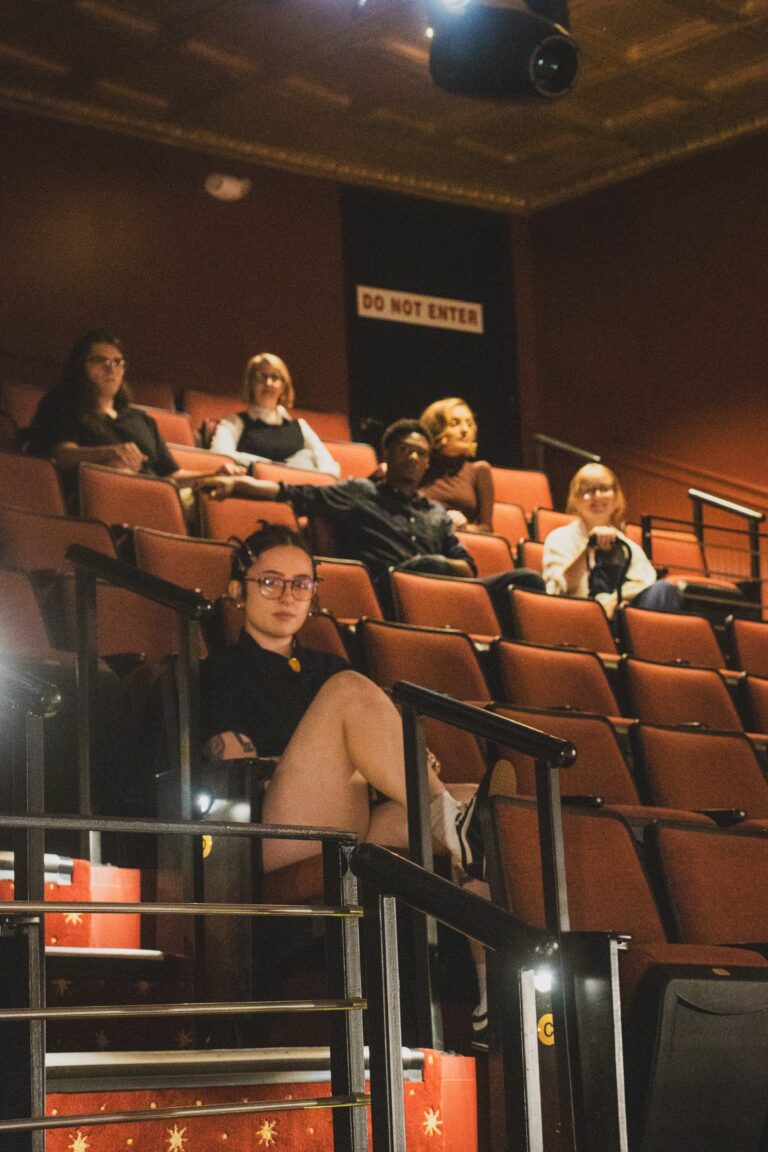
Director Spotlight: Luci Thomas on Heroes of the Fourth Turning
Will Arbery’s Heroes of the Fourth Turning is a gripping contemporary drama that explores faith, politics, friendship, and identity through a late-night reunion of four young Catholic intellectuals in rural Wyoming. Set in 2017 but strikingly relevant today, the Pulitzer Prize-finalist play challenges audiences to wrestle with questions of conviction, belonging, and the future of America.
Director Luci Thomas embraces the complexity of Arbery’s work, bringing an intimate and thoughtful approach to a play driven by conversation rather than spectacle. A graduate of Towson University with concentrations in directing and sound design, Thomas has directed productions including Dog Sees God: Confessions of a Teenage Blockhead, Lord of the Flies, Attic, Radio Hour, and Ruff Ruff Ruff Ruff I’m A Dog, building an emerging body of work that spans Maryland and New York.
We sat down with Luci to discuss what drew them to Heroes of the Fourth Turning, the challenges of directing such a dialogue-driven production, and what they hope audiences will take away from this timely and thought-provoking play.
What drew you to Heroes of the Fourth Turning as a director?
I appreciate Will Arbery’s ability to write characters as real people. I don’t think I’ve read one of his scripts where a character gets flattened or turned into a stereotype by the end. Even though this is technically a work of fiction, it feels like you’re really sitting in this backyard in 2017 with real people dealing with real problems, whether they created those problems for themselves or not.
For those who aren’t familiar with the play, what can audiences expect?
To be blown away, of course! But seriously, expect a lot of political jargon. Even if you don’t understand every reference, don’t worry. I don’t think the characters fully understand it either.
Heroes of the Fourth Turning explores faith, politics, identity, and friendship through the lens of young Americans. What do you think makes these conversations resonate today?
I think there’s still so much resonance today, especially among younger conservatives. Many of the influencers and public figures that young people follow skew to the political right. Think Andrew Tate, Ben Shapiro, Matt Walsh, Joe Rogan, Charlie Kirk, and others. That wasn’t a new phenomenon in 2017. Teresa, who serves as something of the play’s central character, is heavily influenced by political figures like Steve Bannon. The play captures how influential media personalities and political commentators can be for young adults who are trying to figure out where they fit politically.
As the country marks the 250th anniversary of the United States, this play asks big questions about America’s future. Do you see any connection between the conversations in the play and the broader reflection happening during the semiquincentennial?
Absolutely. I think Will Arbery wrote this play expecting the political landscape to change dramatically before the end of Trump’s first term. If these characters could see where the country is today… whoof. It reminds us that the questions they’re wrestling with didn’t end in 2017. They’re still evolving, and we’re still trying to answer them.
This play is driven almost entirely by dialogue. What has been the biggest challenge in directing a production where the tension comes from conversation rather than action?
That’s exactly the challenge: the action is in the conversation. How do you make a scene visually engaging when people are mostly sitting and talking, without distracting from what they’re saying? I’ve really enjoyed working with the actors to create intentional, natural movement. When would someone stand? When would they sit back down? Does this character get upset enough to end up on the ground? Those choices help tell the story just as much as the dialogue.
The characters hold deeply different beliefs, but they’re also longtime friends. How did you work with the cast to portray those relationships authentically?
It was important to put the characters’ beliefs into perspective. The actors don’t necessarily share the same values, but everyone understands what it’s like to wrestle with difficult issues and internal conflicts. We spent a lot of time doing dramaturgical work to find where those struggles resonated with the actors personally. That allowed them to connect with the humanity of the characters rather than simply their politics.
Without giving anything away, is there a particular moment you’re especially excited for audiences to experience?
I actually talked this one over with my stage manager, Joe. There’s no way to hint at the moment we’re most excited about without spoiling it. All I’ll say is… get ready to sit in the splash zone.
What do you hope audiences are discussing on their drive home after seeing Heroes of the Fourth Turning?
Probably something like:
- “Did Plato really predict Trump?”
- “That college isn’t real… right?”
- “Can you Google ‘Transfiguration College of Wyoming?'”
- “Wait… Wyoming Catholic College is a real school?”
- “It’s $43,000 a year?“
Or maybe they’ll just be debating the same questions the characters are. If that happens, I think we’ve done our job.
Heroes of the Fourth Turning will be presented August 6, 7, and 8 at 7 pm and August 9 at 3 pm at the historic Avalon Theatre in Easton, Maryland. Written by Will Arbery and directed by Luci Thomas, the Pulitzer Prize-finalist drama is part of Groove/Factory’s 2026 season.
Tickets and additional information are available at thefactoryartsproject.org/heroes.