
Written by E.T. Wilford
“Chasing the dragon” is a turn of phrase referring to the elusive pursuit of the high experienced during a user’s first use of a drug, a high that can no longer be achieved after acclimation.
“Theatrical convention” is a technique that actors, playwrights, or directors employ to help the audience understand context. For example, mime.
“We are all born mad. Some remain so.”
— Samuel Beckett, Waiting for Godot
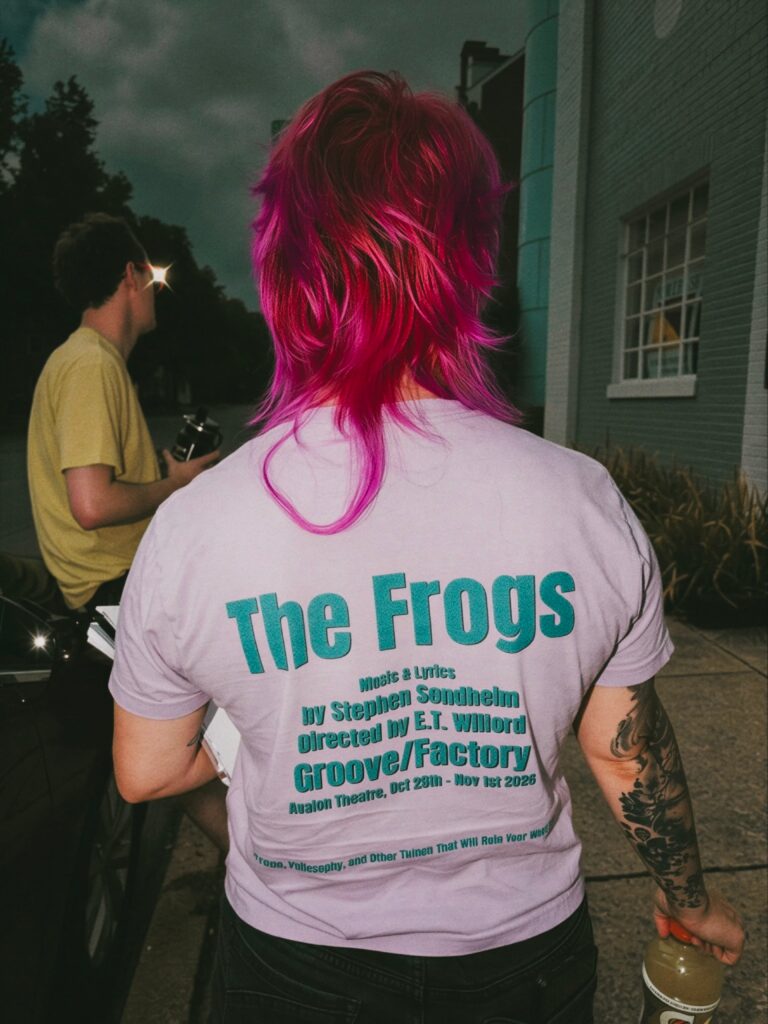
The Frogs (originally written in 405 BC by Aristophanes and adapted by Nathan Lane and Burt Shevelove, with music and lyrics by Stephen Sondheim) will open at the Avalon Theatre on October 29. It is the culmination of 15 or so years of my own dreaming about what this show could look like.
When I first heard this score, I envisioned a massive boat on some kind of cradle that would be built throughout the action of Act I, only to be tossed around on the cradle at the climax, right before intermission, splashing water onto actors, dancers, and choir members all over the stage before a sudden blackout. At the top of Act II, the boat would be torn asunder. To achieve this effect, I would have needed a vaulted ceiling at least three stories high that could also accommodate theatrical lighting equipment. No such venue exists in Talbot County (nor have I ever seen one outside of NYC, and even then, the venues were too narrow).
And so, on again and off again, I have been rearranging, reconfiguring, and redesigning what this play would look like. Even at the beginning of 2026, when I met with my crew to discuss the overall design of what a show of this scale could look like, we knew we would have to pivot. The dances, too difficult. The costumes, too outrageous. A lot of tweaking to make space for this while still honoring the idea of that. And so it goes.
“Everything becomes everything else and it’s all nice and pretty and likeable. Where’s the arbitration that separates what I like from what I respect, what I deem worthy, what has… significance.”
— John Logan, Red
I have said recently to some friends that I find most of my directing projects have fallen short of my own expectations. And do not be mistaken, dear reader: I am not disappointed in the actors who allow me to work with them, nor am I disappointed in the several to dozens of technicians and other artists who specialize in departments of theatre that I have only the haziest understanding of. The time, detail, and attention they give me, and the collaboration they bring to our work, are things that no amount of my money, heart, or time could ever repay.
But I focus on the things I personally could have done better: the sequences I could have made tighter, the lighting I could have made a little better. This is the dragon I pursue. And when I think of all the things I could have done with a little more free time, I remember one thing I hold very true: “Real artists have day jobs.” And we all need to eat.
“This is not hypocrisy, and this is not sophistry. This is reality.”
— Tony Kushner, Angels in America
The Frogs had fantastical beginnings in my young mind. As I navigate the waters of early-stage middle age (more north of 30 than I am south of 40), I have to separate what I yearn for from what I can achieve, and with 20 years of experience, it becomes only a little easier to reconcile the two.
Regardless, The Frogs still metastasized into the largest production I’ve ever helmed. The choir and orchestra together comprise over 20 musicians, the dancers add seven more people, and the principal cast numbers another seven. The designers, directors, producers, managers, and stagehands include over 15 people who have touched this show. This is before you even mention the countless individuals, grantmakers, and community businesses that have contributed to bringing this show to life. Over 50 individuals have contributed their time and creativity to make this show happen in the zaniest, silliest, and most engaging way possible.
The show itself is less than two hours long, including intermission. There are about 40 minutes’ worth of choreography, 70 minutes’ worth of song, and maybe 25 minutes’ worth of plot—which means the show comes at you fast, loud, and funny, with over 50 artists in the theatre ready to strike hilarity into the hearts of an eager and deserving audience.
“I am of the opinion that my life belongs to the whole community, and as long as I live, it is my privilege to do for it whatever I can.”
— George Bernard Shaw
Before the curtain rises, I would be remiss not to thank the countless people who have made an impression on me throughout the cultivation of whatever talents I may have in theatrical convention. After all my years involved in Eastern Shore theatre, I’m proud to know a vast majority of the people who currently make a difference and who have contributed to the scene for decades. It’s been a privilege to work alongside my friends all over the Mid-Shore, to see the maturation of their hard work, and to know that, as I work with them, their work improves upon my own. I would not trade a moment of the time I’ve spent with other artists.
Beyond the social contract of collaboration, I would also be remiss not to mention the countless businesses, community partners, and generous individuals who have brought this enormous show to the surface through their financial contributions. It takes significant financial backing simply to acquire the license to put on a show, especially a musical. It takes a great deal more if you insist on having quality live professional musicians, not to mention professional-grade costume design and top-tier choreography, all coming together under the roof of a community venue as historic as it is prestigious.
All contributors and collaborators will be named in our show program and recognized on opening night, but for now, please know how much your trust in all of us means. A show this large cannot happen every year, or even very often, and to everyone who has helped bring it to fruition: from the bottom of my heart, thank you.
“The experience of writing The Frogs was primarily an academic one. It was an exercise: it offered me a chance to harangue an audience, to use a chorus a cappella to make sound effects, to write massed choral music, and to indulge in vulgarity, adolescent humor and moral preachment, just like Aristophanes.”
— Stephen Sondheim
I’ve never been particularly good at informing the general public why they should see any production of mine beyond my own enthusiasm for it. It’s a bit like listening to the old chamber music. Some of my favorites are the Requiems by Mozart and Verdi (100+ years apart) and some of the string quartets by Brahms, and numerous Saint-Saens, all of which have been accompaniment for various shows of mine. It’s a bit like that. It’s one thing to listen to these 100+ musician chamber orchestra pieces over and over, but to witness it live? For me, I would not pass it up. That is what I’m offering you–but it’s Sondheim’s choral masterpiece. (I’ve never cared much for football or baseball, despite the multimillion-dollar mass appeal behind them, so it’s safe to say I’ve never had conventional tastes.)
I have such specific tastes in storytelling that some may go so far as to call me “pretentious.” Maybe so. I did just make allegory to Brahms, Mozart, and Verdi. And Sondheim was also one of the greatest titans of the American musical theatre in the 20th century. Then again, two of his favorite movies were Team America: World Police and (by the same creators) The South Park Movie. Pretentious? Perhaps. But not without a well rounded sense of taste.
If a manifesto of several pages does not convince you of my own enthusiasm for this show, I’m not sure what will. But I think this offers us a chance to laugh in the face of an increasingly ridiculous world. Let’s be crass, crude, and silly, all together, all at once, if not for just a little while.
The Frogs is ridiculous; it’s funny, and it’s stupid. It’s a lot of fun to watch. I hope to see you in the audience. It would mean a great deal to me personally, as well as to the 50+ artists and collaborators behind the absurdist beauty of it all. You deserve a laugh. Don’t we all?
“We need to touch people’s hearts as well as their minds. Remind people what’s right with them, as well as what’s wrong with them.”
— Aristophanes, The Frogs
The Frogs will be presented October 29 and 30 at 8 pm, October 31 at 9 pm, and November 1 at 3 pm at the historic Avalon Theatre in Easton, Maryland. Written by Aristophanes, adapted by Burt Shevelove and Nathan Lane, music and lyrics by Stephen Sondheim, music direction by Amy Morgan, and directed by E.T. Wilford, the 2,400-year-old musical comedy is part of Groove/Factory’s 2026 season.
Tickets and additional information are available at thefactoryartsproject.org/frogs.